
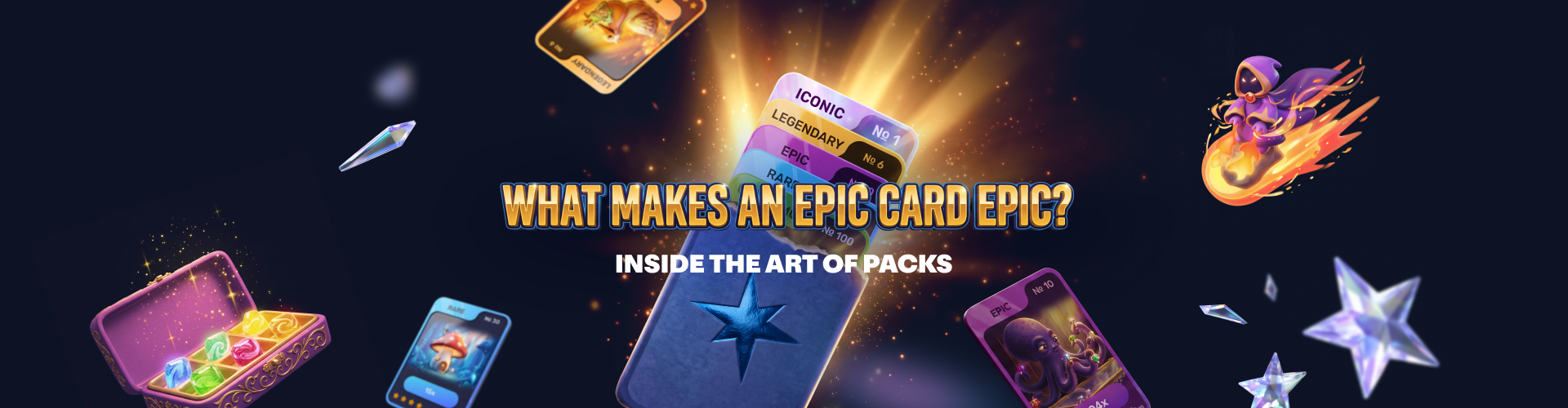
What Makes an Epic Card Epic? Inside the Art of Virtual Game Packs


In our second interview on Packs, we sit down with 2D artist Marta Khomiakova, who built rarity into the illustrations themselves.
In most card games, rarity is a colour on the border. In Packs, it is the size of the story. The Packs Epic card is where that idea really opens up: the scene gets busier, the cast gets bigger, and the world behind the card starts to show through.
Packs is ICONIC21’s collectible card-themed virtual instant game, launched in September 2026. Every round starts with a pack, and the cards inside belong to groups with their own characteristics, rarity and payout potential. Behind the artwork is 2D artist Marta Khomiakova, who built rarity into the illustrations themselves.
Where the Epic card sits in Packs
Packs cards come in four tiers: Uncommon, Rare, Epic and Legendary. Epic sits one step below the top. It is the tier where a scene stops being a single moment and starts reading like a chapter.
Marta explains the system plainly:
“The rarity is reflected through several visual elements: the complexity of the story, the number of objects and details in the scene, the composition, and the characters involved. As the rarity increases, the scenes become richer and more elaborate, with more elements contributing to the overall story.”
So an Epic card carries more of all four than the Rare card beneath it. There are more objects to find, more characters in frame, a more ambitious composition and more story packed into one image.
Rarity you can read, not just see
That approach changes how players look at a card. A Packs Epic card rewards a second look, because the extra detail is not decoration. Each added element is there to move the story along.
It also starts from somewhere ordinary. “Ordinary things can become much more interesting when you look at them through the lens of imagination and fantasy,” Marta says. Her starting points were video games, familiar objects and small everyday things that make people happy. The higher the tier, the further those ordinary things get pushed into fantasy.
One world, one very bad wizard
The cards do not stand alone. Small visual references link one card to the next, building a world bigger than any single scene. At the centre is an evil wizard who travels between worlds.
“He dreams of becoming the most evil wizard in the world, but somehow, everything he does ends up bringing about something good.”
On an Epic card, with more room for characters and detail, there is more space for his plans to go wrong in interesting ways.
What goes into a complex scene
Marta’s toughest card to design shows the work behind a detailed illustration. It features a chicken that has just laid a golden egg. She wanted the scene to feel mysterious, gave the chicken “an almost aristocratic personality”, and added movement and energy. The golden cave around it had to feel rich and immersive too.
Most of that was settled before the final art began. The compositions were planned in detail upfront, so the illustrations changed very little between first concept and final card. The finishing work was about refining and bringing ideas to life, not rethinking them.
Built for curiosity
The aim across every tier is the same: a sense of curiosity and wonder. Marta wanted players to look closer and find something new in every scene. Asked what a day inside Packs would feel like, she described bright, completely different worlds with unexpected twists, where you never quite know where the story goes next.
If Packs ever became a video game, she sees it as a fantasy role-playing game. The evil wizard would travel with you through different worlds, failing at evil the whole way, while you explore new places and meet unusual characters.
Share this post